Heading to AHR Expo 2026? Here is a subject that has captivated my attention.
Natural gas still powers a significant portion of commercial boilers, water heaters, furnaces, and indirect heating in rooftop units or VRF-hybrid setups. These systems contribute NOx, CO, and trace CH4 emissions that degrade IAQ and add to Scope 1 carbon footprints.
Hydrogen (H₂) offers a lower-carbon alternative: when burned, it produces water vapor and heat with zero direct CO₂ emissions, while a full transition to 100% H₂ is a warm possibility in the near future.
Recent research spotlighted at AHR Expo sessions (e.g., the AHRI & GTI Energy presentations on “Decarbonizing Commercial Heating with Hydrogen – Boilers, Water Heaters & HVAC”) is defining those practical upper limits through rigorous testing at GTI Energy and UC Irvine labs.
Key findings from ongoing California Energy Commission-funded projects include:
- Blending limits: Many commercial boilers and water heaters maintain stable operation, efficiency, and capacity with 20-50% H₂ blends; some designs approach higher blends or full conversion.
- Efficiency impacts: Minimal derating in heating capacity (often <5-10% at mid-blends), with potential NOx reductions of 50-90% depending on burner technology.
- Emissions profile: Near-zero CO and CH₄ slip; H₂ slip monitored via novel sampling methods.
- Material compatibility: Testing on common alloys shows manageable hydrogen embrittlement risks with proper material selection and safety protocols.
- Safety & operations: No major flame instability in tested equipment; flashback prevention and leak detection remain critical.
These aren’t theoretical—parallel material exposure tests simulate long-term H₂ combustion environments, informing future codes and standards.
Tying It to Air Conditioning and IAQ Upgrades
While most current hydrogen work focuses on heating, the implications for cooling are compelling in commercial hybrid systems:
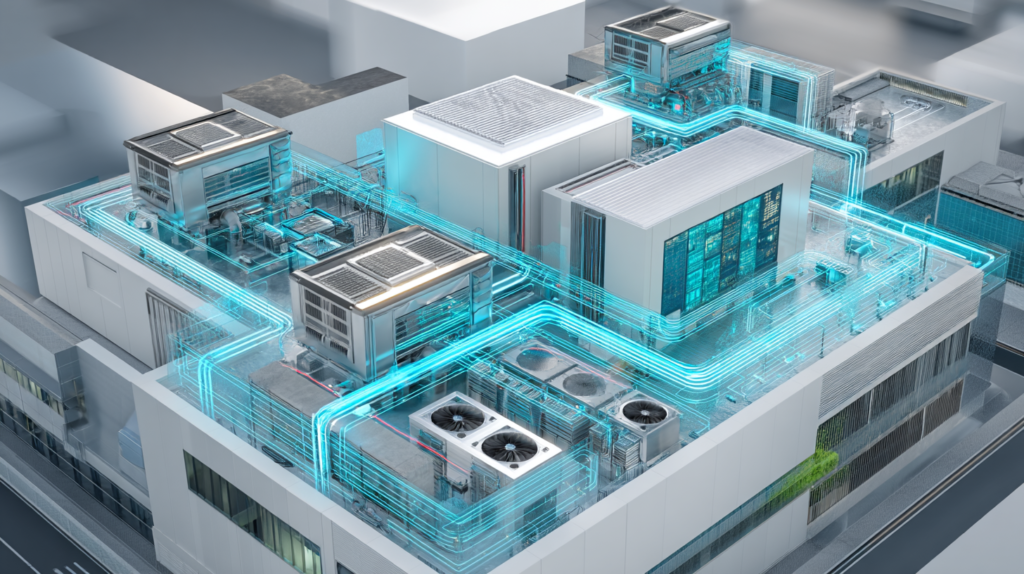
- Hydrogen boilers or fuel cells could generate electricity and waste heat on-site, powering electric chillers or driving absorption chillers (e.g., via high-temperature H₂ combustion heat).
- In district energy or large campuses, clean H₂-derived heat could feed desiccant wheels or hybrid VRF setups, reducing reliance on grid electricity for cooling while eliminating local combustion pollutants.
- IAQ win: Zero NOx/CO from heating means cleaner recirculated air, especially in tight-envelope buildings. Combined with advanced filtration (MERV 13+ or HEPA), this supports healthier indoor environments without added energy penalties.
Real-world potential: COPs >4.0 in integrated systems, 50-70% lower operational emissions vs. natural gas equivalents, and synergy with on-site green hydrogen production from renewables (electrolysis powered by solar/wind).
Challenges Ahead
- Infrastructure: a full transition to 100% H₂ would require significant infrastructure upgrades to manage material embrittlement and its lower volumetric energy density.
- Design: While hydrogen eliminates NOx from fuel-bound nitrogen, its high combustion temperature requires advanced burner designs to prevent increased thermal NOx from the air.
- Cost: Green H₂ production remains expensive, though falling with scale.
- Retrofitting: Not all equipment is “H₂-ready” yet—blends offer a bridge.
Yet with global net-zero targets accelerating, hydrogen isn’t fringe—it’s a pragmatic complement to electrification.
Heading to AHR Expo 2026? Catch the AHRI/GTI sessions on Tuesday (11:30 a.m.) for the latest test data. Or drop by ASHRAE tracks on decarbonization.
What are your thoughts? Is hydrogen blending a viable near-term play for commercial HVAC, or should we double down on full electrification? Would love to hear from engineers, facility managers, and manufacturers on real-world barriers or pilots.
Let’s connect at the show if you’re attending—always open to discussing how these innovations fit VRF, commercial cooling, and sustainability goals.